
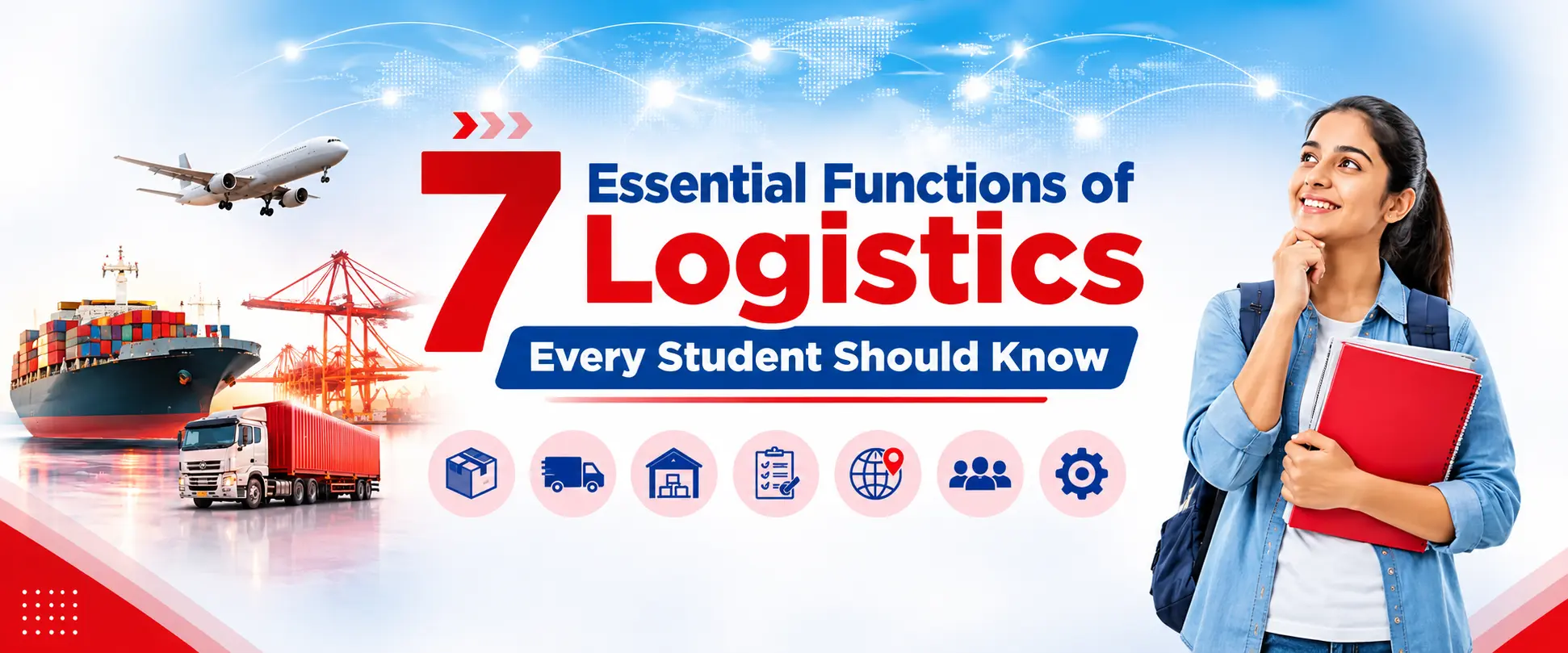
Every time you order a phone online, buy vegetables at a supermarket, or receive a parcel at home, logistics is working behind the scenes. It is the process that gets the right product to the right place, at the right time, in the right condition and at the right cost.
India’s logistics sector employs millions of people, and it keeps growing with e-commerce, manufacturing and exports. If you are considering a career in this field, start by understanding its seven core functions.
Table of Contents
1. Transportation
Transportation moves goods from one place to another by road, rail, air or sea. It is usually the biggest cost in logistics, so choosing the right mode matters.
For example, fresh flowers travel by air to stay fresh, while heavy machinery goes by sea or rail to keep costs low.
What you will learn: route planning, freight rates, mode selection and fleet management.
2. Warehousing
Warehouses store goods safely until they are needed. A modern warehouse is not just a storage room. It receives, sorts, stores, picks and dispatches goods efficiently.
Think of a large e-commerce warehouse: thousands of products must be stored so that any item can be found and packed within minutes.
What you will learn: warehouse layout, storage methods, picking and dispatch, and warehouse management systems (WMS).
3. Inventory Management
Inventory management means keeping the right amount of stock. Too much stock blocks money and space. Too little means lost sales and unhappy customers.
A medical store that runs out of a common medicine loses customers, while one that overstocks loses money when the medicine expires.
What you will learn: stock control methods like FIFO and ABC analysis, reorder levels, and demand forecasting.
4. Order Processing
Order processing covers everything from the moment a customer places an order to the moment it is ready for dispatch. This includes receiving the order, checking stock, preparing invoices and arranging shipment.
Speed and accuracy are important here. A wrong or delayed order directly affects customer trust.
What you will learn: order cycle, billing, documentation and the use of ERP software.
5. Packaging and Material Handling
Good packaging protects goods from damage during storage and transport. Material handling is the movement of goods inside the warehouse, using tools like forklifts, pallets and conveyor belts.
Packaging also affects cost and the environment. Lighter, recyclable packaging reduces both.
What you will learn: packaging types, labelling, barcodes, safe handling and equipment use.
6. Procurement
Procurement means buying the raw materials, goods or services a business needs. A good procurement team finds reliable suppliers, negotiates prices and makes sure materials arrive on time.
Without procurement, factories cannot produce and shops cannot sell.
What you will learn: supplier selection, purchase orders, negotiation and vendor management.
7. Customer Service and Delivery
The final step is delivering the product and supporting the customer. This includes on-time delivery, shipment tracking, handling returns and resolving complaints.
In today’s market, customers expect fast delivery and clear updates. Strong customer service often decides whether they buy again.
What you will learn: last-mile delivery, tracking systems, returns management and service quality.
How These Functions Work Together
These seven functions are connected. A delay in procurement affects inventory. Poor packaging causes damage in transport. Weak inventory control leads to late deliveries. A skilled logistics professional understands the whole chain, not just one part.
Why Learn Logistics?
- Strong demand for trained professionals across industries
- Job roles in warehouses, shipping companies, e-commerce, manufacturing and retail
- Opportunities for freshers, graduates and working professionals
- A career path that grows with experience, from executive to manager
Start Your Logistics Career Today
A professional logistics and supply chain management course gives you practical knowledge of all seven functions, along with industry software, real-world case studies and placement support.