
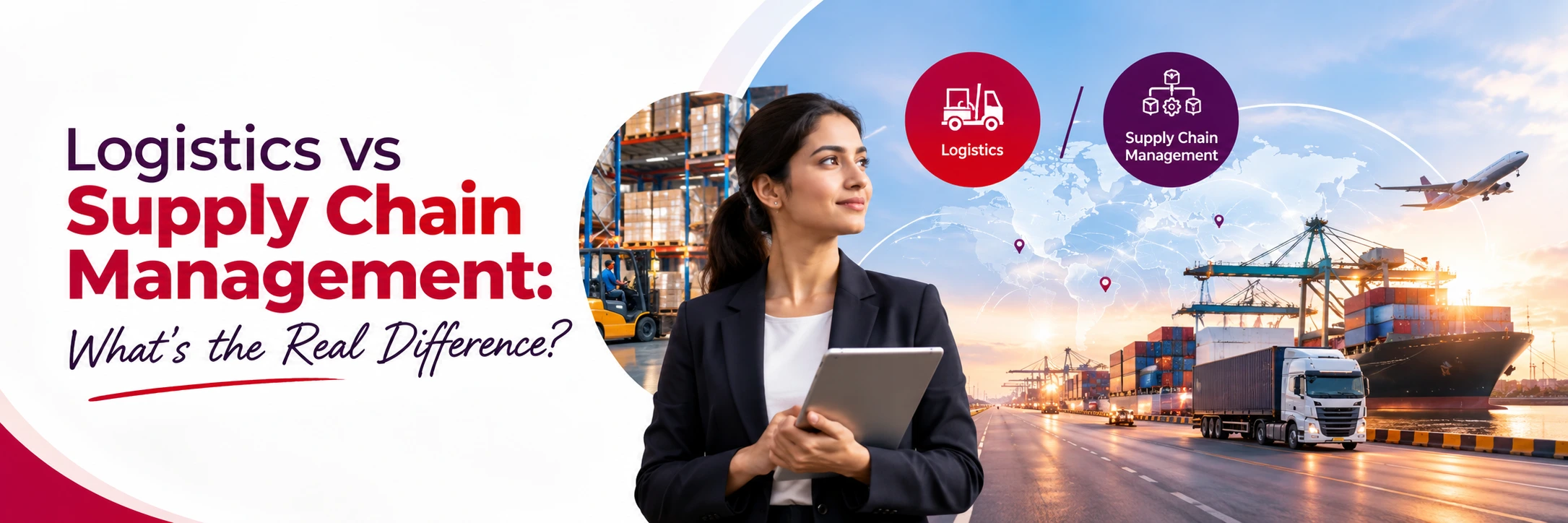
If you’re exploring a career in this field, you’ve probably noticed that “logistics” and “supply chain management” are often used interchangeably — in college brochures, job postings, and even casual conversation. But they aren’t quite the same thing. Understanding the difference can help you choose the right course, the right specialization, and ultimately, the right career path.
Table of Contents
What Is Logistics?
Logistics refers to the movement, storage, and flow of goods from one point to another. It’s the “how” of getting a product from a warehouse to a customer’s doorstep.
Logistics typically covers:
- Transportation (road, air, sea, rail)
- Warehousing and storage
- Inventory handling
- Packaging
- Order fulfilment and delivery
In simple terms, logistics is one piece of a much bigger puzzle. It’s focused on execution — physically moving goods efficiently, on time, and at the right cost.
What Is Supply Chain Management?
Supply Chain Management (SCM) is the bigger picture. It covers the entire journey of a product — from raw material sourcing, to manufacturing, to logistics, all the way to the final customer, and sometimes even the return process after that.
Supply Chain Management typically covers:
- Supplier and vendor relationships
- Procurement and sourcing
- Production planning
- Logistics and distribution (yes, logistics sits inside SCM)
- Demand forecasting
- Customer relationship and after-sales flow
Think of supply chain management as the strategy, and logistics as one of the operational functions within that strategy.
Logistics vs Supply Chain Management: Side-by-Side
| Aspect | Logistics | Supply Chain Management |
|---|---|---|
| Scope | Narrower — movement and storage of goods | Broader — sourcing to delivery, end-to-end |
| Focus | Execution and operations | Strategy and coordination |
| Key Activities | Transportation, warehousing, delivery | Procurement, production, logistics, forecasting |
| Relationships Involved | Carriers, warehouses, delivery partners | Suppliers, manufacturers, logistics providers, customers |
| Goal | Move goods efficiently and on time | Optimize the entire flow for cost, speed, and customer satisfaction |
A Simple Way to Remember It
Imagine ordering a phone online.
Logistics is what happens after you click “buy” — the warehouse picks your order, packs it, and a delivery partner brings it to your door.
Supply Chain Management is everything that happened before that too — the company sourcing raw materials, the factory manufacturing the phone, the distributor moving it to a warehouse, and the demand planning that ensured that warehouse had stock in the first place.
Logistics is a chapter. Supply chain management is the whole book.
Why This Difference Matters for Your Career
If you’re choosing between courses like an MBA in Logistics vs an MBA in Supply Chain Management, this distinction actually matters:
- Logistics-focused roles tend to be more operational — warehouse managers, transportation coordinators, freight and fleet managers, delivery operations roles.
- Supply chain-focused roles tend to be more strategic — procurement managers, supply chain analysts, demand planners, and roles that require coordinating across multiple departments and vendors.
That said, in most companies, especially in India, the two functions overlap heavily, and many professionals move fluidly between both. Understanding the distinction simply helps you know what kind of day-to-day work excites you more: hands-on execution, or big-picture coordination.
The Bottom Line
Logistics and Supply Chain Management aren’t rival fields — logistics is a core function within the larger supply chain. Whether you’re drawn to the operational side (getting things moved, stored, and delivered) or the strategic side (planning how an entire product journey comes together), both paths lead to strong, in-demand careers as e-commerce and global trade continue to grow.